
7 Office E-Waste Disposal Mistakes Companies Should Avoid
The average office generates more electronic waste than most companies realise. Laptops replaced after three years. Monitors upgraded during a renovation. Printers retired after a single department restructure. Phones cycled out with every new policy update. Each of these devices quietly piles up, and at some point, someone has to decide what to do with them.
That decision matters far more than most businesses appreciate.
The Global E-Waste Monitor reports that the world generated 62 million metric tons of e-waste in 2022, a figure projected to climb to 82 million metric tons by 2030. Yet only 22.3% of that waste received proper collection and recycling. The remaining bulk, including a significant share from corporate offices, ends up in landfills, informal recycling chains, or storage rooms where it creates compounding risks over time.
For businesses, improper e-waste disposal is not just an environmental concern. It is a data security liability, a compliance exposure, a reputational risk, and in many jurisdictions, a direct legal violation. The financial cost of getting it wrong is documented in nine-figure lawsuits, multi-million dollar regulatory fines, and the long-term erosion of customer trust.
This guide walks through the seven most common office e-waste disposal mistakes companies make and explains exactly what each mistake costs, why it happens, and what to do instead.
Table of Contents
- Throwing E-Waste Into the Regular Trash or General Recycling Bin
- Disposing of Devices Without Wiping Sensitive Data
- Partnering With Uncertified or Unvetted E-Waste Recyclers
- Having No Formal E-Waste Policy or Disposal Protocol
- Hoarding Old Electronics in Storage Rooms Indefinitely
- Skipping Asset Tracking and Chain-of-Custody Documentation
- Failing to Train Employees on E-Waste Disposal Procedures
- FAQ: Corporate E-Waste Disposal
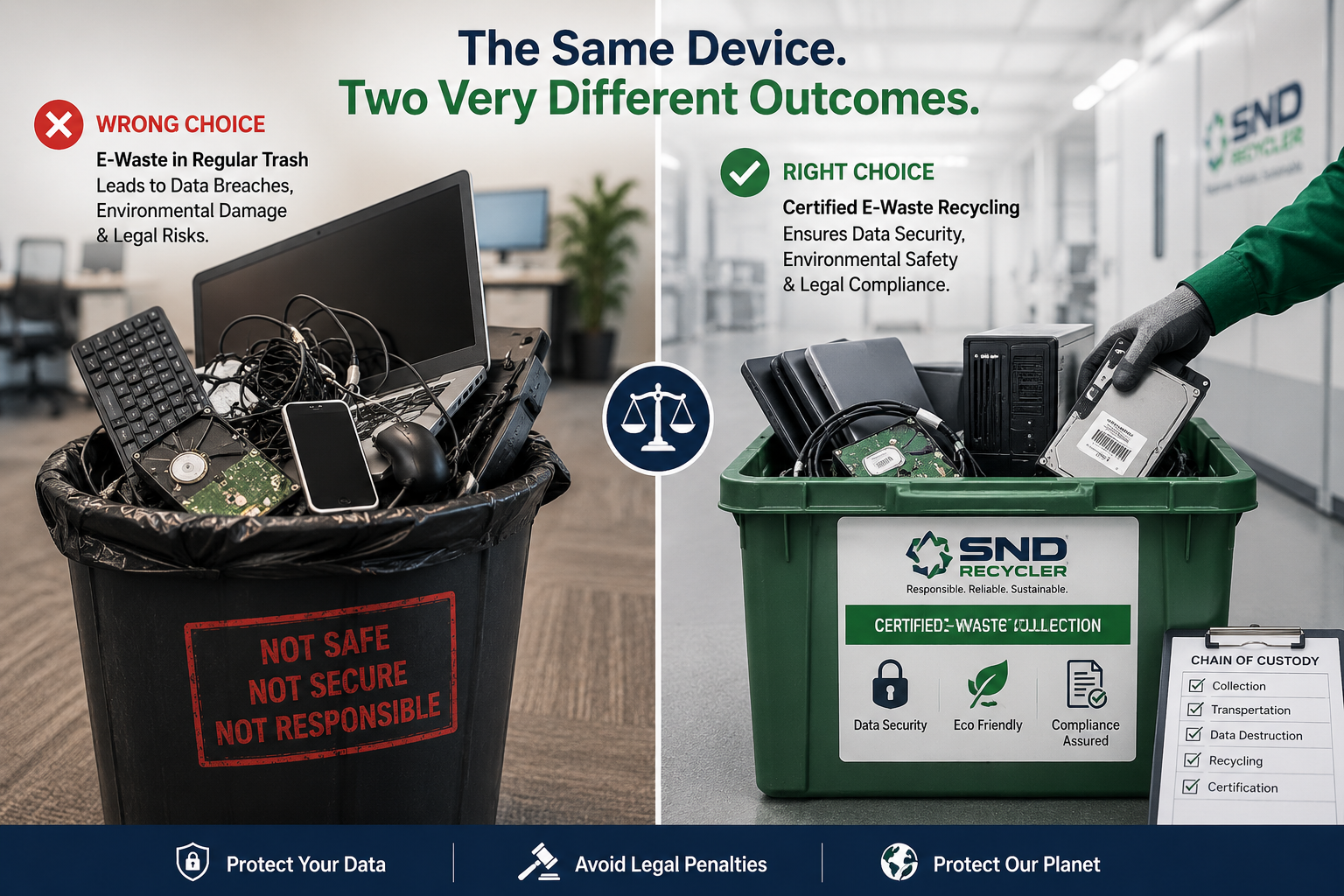
Mistake 1: Throwing E-Waste Into the Regular Trash or General Recycling Bin
Why Companies Do It
It seems like the simplest option. An employee's laptop stops working. A projector gets replaced. Someone drops an old smartphone in the bin on their way out the door. In the absence of a clear alternative, the trash becomes the default.
Why It Is a Serious Problem
Electronic devices contain a cocktail of dangerous materials: lead, mercury, cadmium, beryllium, brominated flame retardants, and lithium compounds. When these materials enter landfills, they leach into soil and groundwater over time, creating long-term environmental damage that extends well beyond the business that discarded the device.
Electronic waste is already responsible for 70% of the toxic chemicals found in landfills globally. Up to 85% of all e-waste still ends up in landfills or incinerators rather than proper recycling facilities. The devices your office discards today can remain chemically harmful for decades.
Beyond the environmental damage, there is a direct legal risk. The U.S. EPA and many international regulatory bodies classify certain electronic components as risky waste. Violations of EPA and RCRA high-risk waste rules can result in fines up to $70,117 per day per violation. California imposes fines ranging from $1,000 to $50,000 per violation for improper e-waste disposal. Washington state charges $1,000 per day of non-compliance.
For companies operating across multiple regions, those numbers stack up quickly.
What to Do Instead
Identify a certified bulk e-waste recycler before your next equipment refresh. Establish a dedicated collection point within your office where end-of-life electronics are staged for proper pickup. No device, regardless of how small or outdated, should enter the regular waste stream.
Mistake 2: Disposing of Devices Without Wiping Sensitive Data
Why Companies Do It
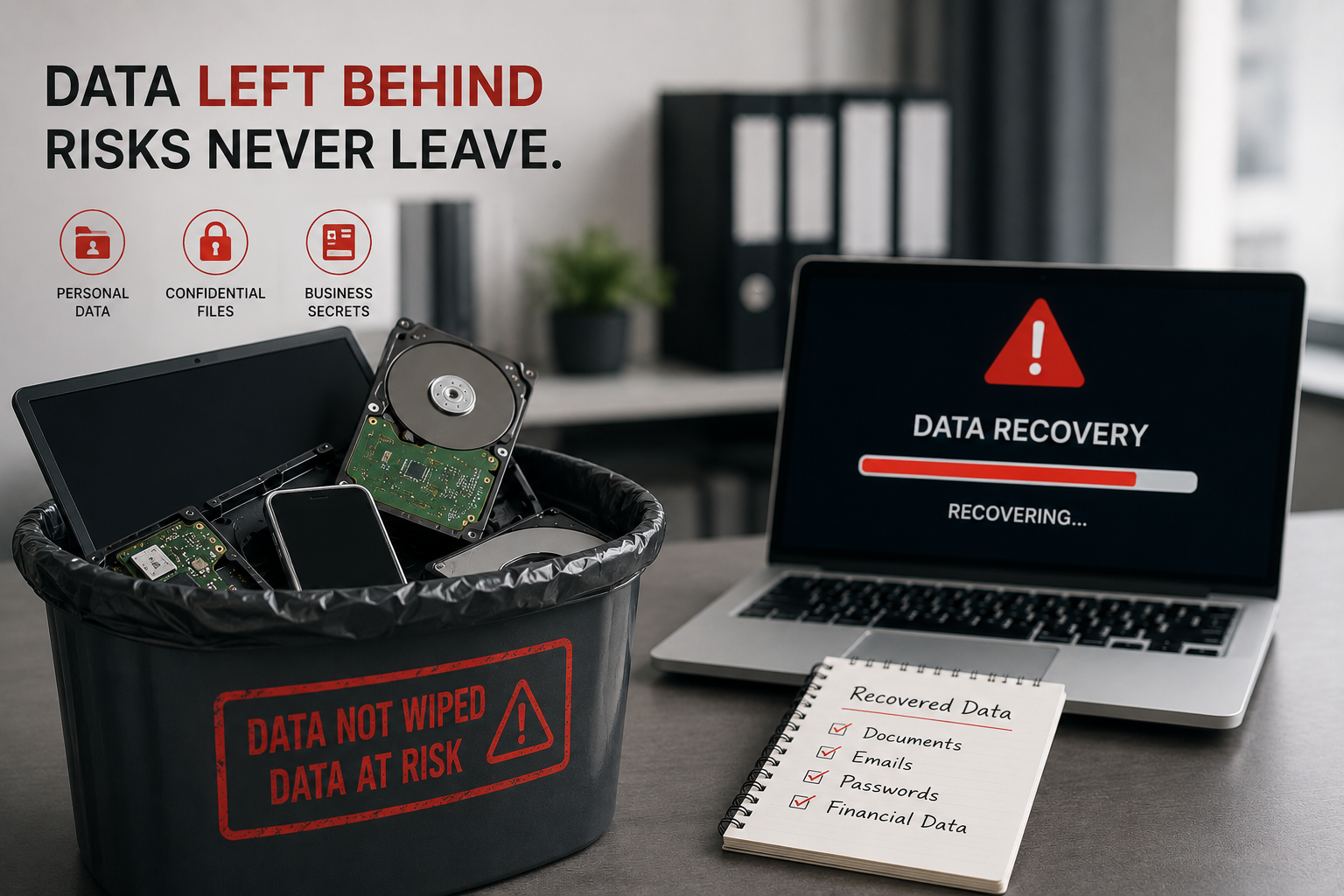
Most businesses assume that deleting files, performing a factory reset, or formatting a hard drive is sufficient before disposal. It is not. This is one of the most dangerous misconceptions in corporate IT practice.
Why It Is a Serious Problem
Standard file deletion only removes the file system pointer. The underlying data remains on the storage media and can be recovered in minutes using freely available forensic tools. A landmark study by Blancco Technology Group found that 42% of used hard drives purchased on secondary markets contained recoverable personal and corporate data.
The consequences of a data breach originating from an improperly disposed device are severe and well-documented.
Morgan Stanley was fined $60 million by the Office of the Comptroller of the Currency in 2020 after failing to properly oversee the decommissioning of data center equipment. Unencrypted customer data was found on devices that had been resold by a vendor. The SEC added another $35 million fine in 2022. The total cost to Morgan Stanley approached $100 million, originating from a vendor oversight failure during device disposal.
Affinity Health Plan returned leased copiers without wiping internal hard drives. Those drives contained protected health information for 344,579 individuals. HHS imposed a $1.2 million penalty. Copiers, like computers, are data-bearing devices. They are frequently overlooked.
The global average cost of a data breach reached $4.88 million in 2024, a 10% increase from the prior year and the highest figure ever recorded. For healthcare organisations, that average climbs to $9.77 million. Additionally, 67% of consumers say they would stop doing business with a company that experienced a data breach.
The data risk does not disappear when a device leaves your office. It follows the device, wherever it goes.
What to Do Instead
Implement certified data destruction as a non-negotiable step before any device leaves your premises. Certified data sanitisation follows standards such as NIST SP 800-88, which defines three levels of destruction based on data sensitivity. For devices that will be physically destroyed, hard drive shredding is the most reliable method. Always obtain a Certificate of Data Destruction from your recycling partner and retain it for compliance documentation.
Mistake 3: Partnering With Uncertified or Unvetted E-Waste Recyclers
Why Companies Do It
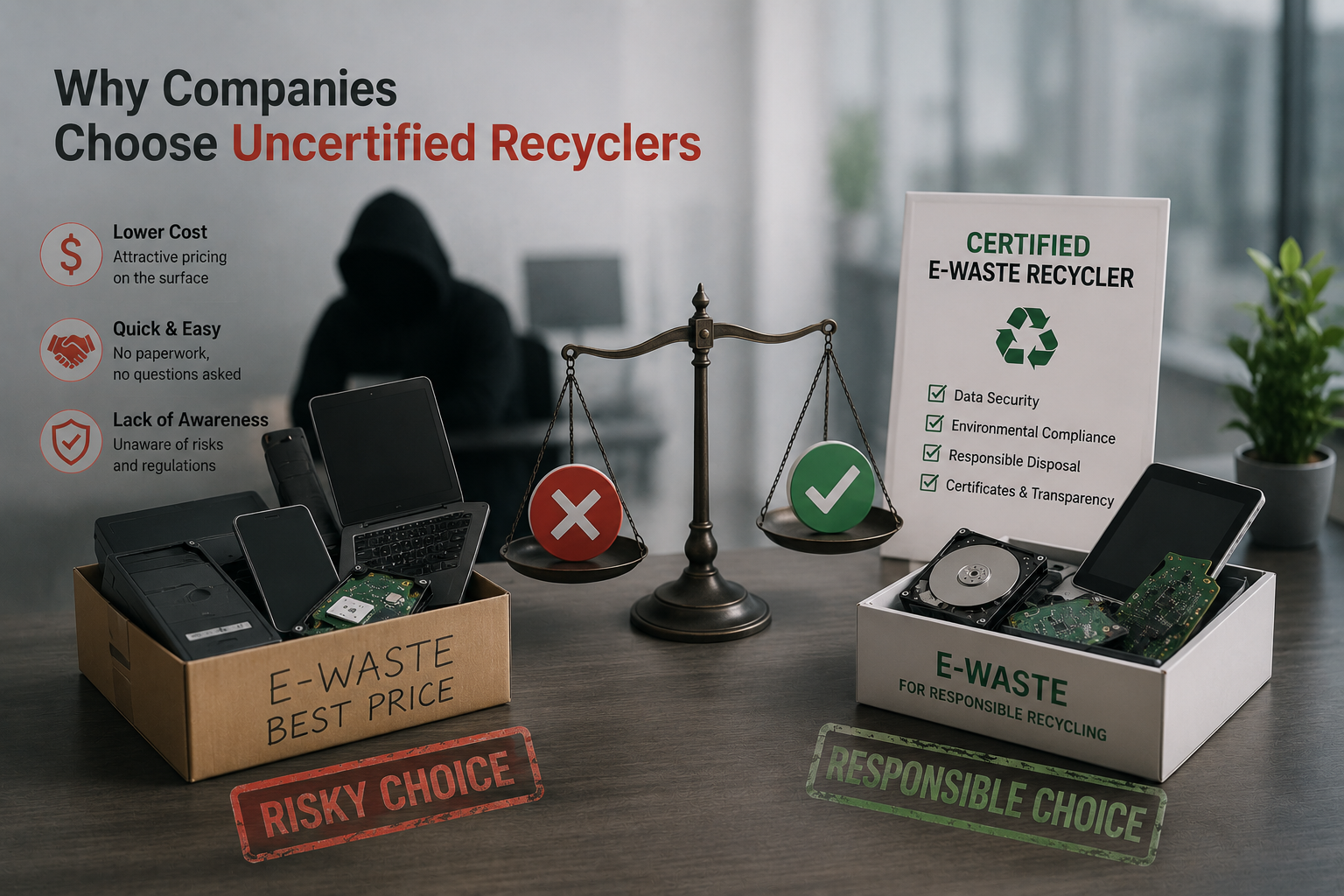
Cost is typically the driving factor. An uncertified recycler often offers free pickup or lower fees because it does not invest in proper processing infrastructure, environmental compliance, or data security protocols. For a procurement manager focused on reducing overhead, the deal looks attractive.
Why It Is a Serious Problem
Under the U.S. RCRA framework, businesses operate under a "cradle to grave" liability principle. That means your company remains legally responsible for the e-waste it generates, even after handing it off to a third party. If your recycler illegally dumps electronics, exports them to informal processing sites in developing countries, or sells devices without wiping data, your business shares liability for those outcomes.
Apple was fined $450,000 after California regulators found improper e-waste handling at its shredding facilities. Comcast paid over $25 million for similar violations. These are not small businesses operating without resources. They are large corporations that underestimated the compliance requirements of their recycling partnerships.
Some individuals and industries actively pose as legitimate e-waste recyclers to harvest personal and corporate data from collected devices. Your devices do not need to reach a landfill to become a security problem. They only need to pass through the wrong hands.
The informal e-waste sector in many regions operates with zero data security oversight, which is precisely why 48 million tons of e-waste per year moves through processing chains that offer no accountability.
What to Do Instead
Work exclusively with recyclers certified under recognised standards. The two most important certifications in the e-waste industry are R2 (Responsible Recycling) and e-Stewards. Both require audited environmental and data security practices. Verify that your recycler provides documented chain-of-custody records and Certificates of Recycling for all materials processed. SND Recycler operates with full certification and documentation standards so that every kilogram of e-waste your business generates is traceable from collection to final disposition.
Mistake 4: Having No Formal E-Waste Policy or Disposal Protocol
Why Companies Do It
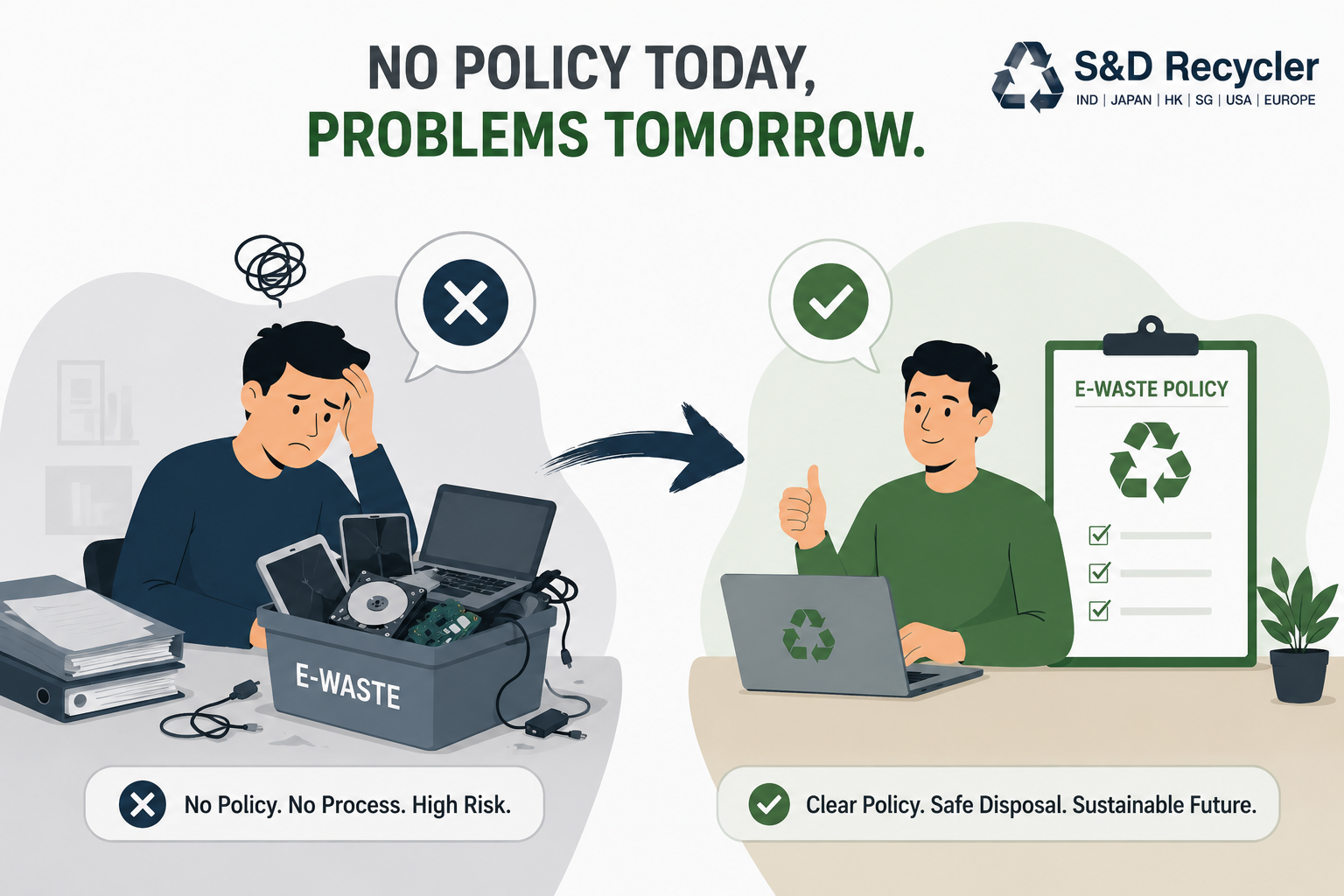
E-waste disposal is rarely viewed as a strategic priority. It sits at the intersection of IT, facilities, legal, and sustainability functions, and with no clear owner, nothing gets formalised. Decisions are made ad hoc, department by department, often by whoever happens to be managing a refresh project at the time.
Why It Is a Serious Problem
Without a formal policy, disposal decisions are inconsistent. One department properly routes devices to a certified recycler. Another stores old monitors in a supply closet. A third lets employees take home outdated laptops without any data wipe confirmation. Each of these gaps represents a compliance exposure.
Regulations governing e-waste disposal vary by jurisdiction and industry, and they are tightening. As of 2024, 81 countries have documented e-waste policies or legislation, and regulators across multiple jurisdictions are increasing enforcement activity against businesses. HIPAA, GDPR, CCPA, PCI-DSS, and dozens of state-level regulations can all be triggered by a single improperly disposed device.
A 22.7% increase in the share of organisations paying regulatory fines exceeding $50,000 was noted in IBM's Cost of a Data Breach Report 2024. Many of those fines originated from preventable disposal failures, not sophisticated cyberattacks.
Without a policy, there is also no audit trail. When regulators or litigants ask how a specific device was handled, the company has no answer.
What to Do Instead
Develop a written e-waste disposal policy that covers device classification, data destruction requirements, approved recycling partners, documentation procedures, and employee responsibilities. Assign clear ownership of the process, whether that sits with IT, legal, or a dedicated sustainability function. Review and update the policy annually as regulations evolve. Align the policy with your broader ESG commitments, because investors and enterprise customers are increasingly evaluating vendors on environmental governance criteria.
Mistake 5: Hoarding Old Electronics in Storage Rooms Indefinitely
Why Companies Do It
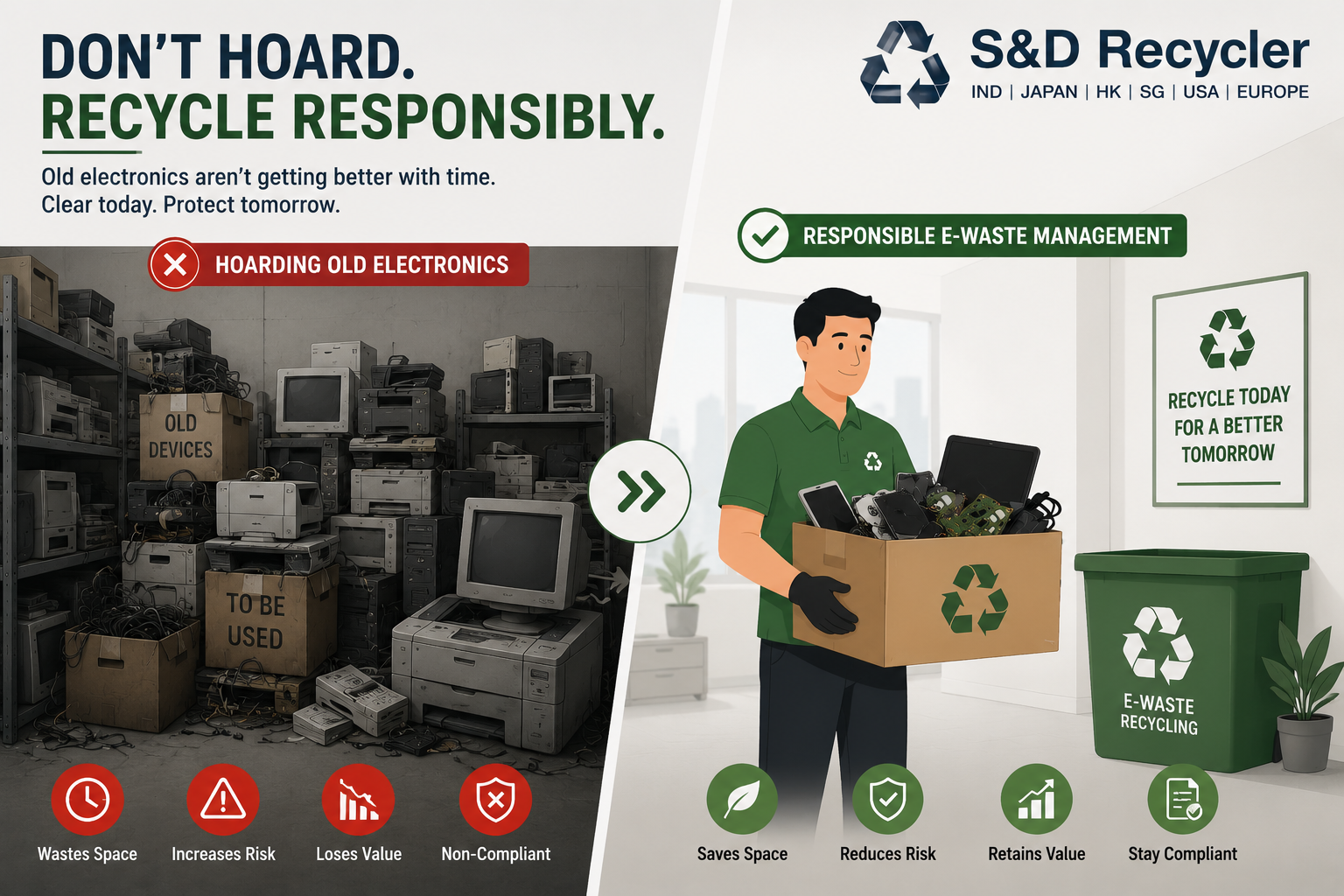
Businesses often hold onto outdated equipment because of uncertainty. Someone assumes the devices might still be useful. A manager believes the IT team will handle them eventually. A project gets deprioritised. Over months and years, storage rooms accumulate stacks of old monitors, towers, printers, cables, and phones with no plan for what happens next.
Why It Is a Serious Problem
Hoarded electronics are not a neutral situation. They are an active liability in at least three respects.
First, devices in storage still contain data. An old laptop sitting in a closet for four years still holds whatever was on it when it was retired. That data remains recoverable. If the device is eventually disposed of without proper sanitisation, the exposure is identical to if it had been discarded immediately.
Second, over 20% of data breaches stem from improperly disposed devices, and a significant portion of those incidents begin with assets that were not formally tracked during their retirement period. "Ghost assets," devices that are off the books and out of the IT management system, represent security risks, financial waste, and compliance gaps simultaneously.
Third, the longer devices sit in informal storage, the less recoverable value they retain. Electronics depreciate rapidly. A laptop worth $200 in secondary market value today may be worth $50 in two years and nothing in four. Every month of hoarding is lost asset recovery revenue.
There is also an environmental dimension. Lithium-ion batteries, common in laptops, tablets, and phones, degrade over time and can pose fire risks when stored improperly. Several warehouse fires have been attributed to degraded battery stockpiles.
What to Do Instead
Set a maximum retention period for retired devices, typically 30 to 90 days from decommissioning. Establish a scheduled pickup cadence with your e-waste partner rather than waiting for storage rooms to overflow. Use asset tracking software to ensure every device is accounted for from procurement through final disposition. Bulk e-waste management companies like SND Recycler can handle large-volume collections on a scheduled basis, making it practical to clear backlogs and maintain a regular refresh cycle.
Mistake 6: Skipping Asset Tracking and Chain-of-Custody Documentation
Why Companies Do It
Documentation feels like administrative overhead. Many companies focus on the physical act of disposal and consider the matter closed once devices leave the building. The paperwork, serialised tracking, certificates, audit logs, seems like an unnecessary formality.
Why It Is a Serious Problem
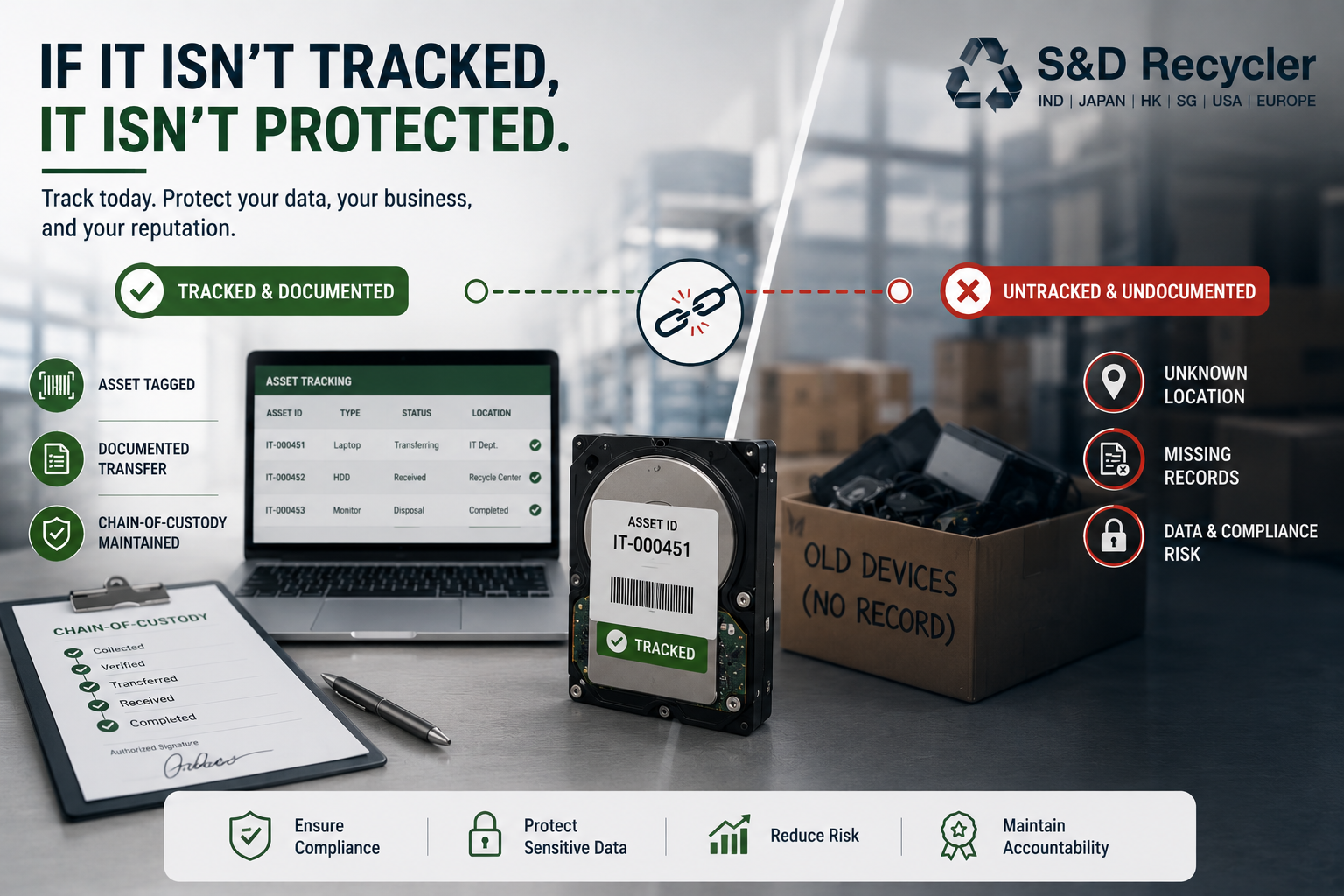
Documentation is the difference between compliance and liability. When regulators, auditors, or litigants investigate a data breach or environmental violation, the question is not just what happened to the device but what evidence exists to prove it was handled correctly.
CISA guidance emphasises that businesses must document every step of the sanitisation and disposal process, including certificates of destruction, serialised reporting, and chain-of-custody records. These are requirements, not recommendations. Regulations including HIPAA, GDPR, and PCI-DSS all require documented evidence of data protection throughout the asset lifecycle, including at disposal.
Without documentation, a company cannot prove that a device was wiped before recycling, that the recycler it used was certified, that the device actually reached the recycler and was not diverted, or that it identified and accounted for all data-bearing assets. Breaches traced to disposed devices result in an average of 73 days of significant business disruption before containment. Class action lawsuits, notification costs, forensic investigation expenses, and credit monitoring services for affected individuals all follow. None of those costs are recoverable without documentation establishing that the company followed reasonable procedures.
What to Do Instead
Require a Certificate of Data Destruction for every device disposed of through your recycling partner. Maintain serialised asset records that link each device to its destruction documentation. Use a centralised IT asset management system that tracks devices from procurement through final disposition. Conduct annual audits to reconcile your asset inventory against disposal records. A reputable bulk e-waste partner will provide all of this documentation as a standard part of their service.
Mistake 7: Failing to Train Employees on E-Waste Disposal Procedures
Why Companies Do It
Employee training on e-waste feels like a niche topic. Security training, compliance training, onboarding processes, and professional development all compete for limited time. E-waste disposal gets treated as an IT or facilities concern, not something every employee needs to understand.
Why It Is a Serious Problem
Human error contributes to 28% of all data breaches, according to Verizon's 2024 Data Breach Investigations Report. Improper device disposal ranks among the top preventable mistakes in that category. Employees at every level make disposal decisions: the sales rep who wipes a work phone and sells it privately, the office manager who donates old computers to a charity without IT sign-off, the finance director who assumes that returning a leased copier with its hard drive intact is the vendor's problem.
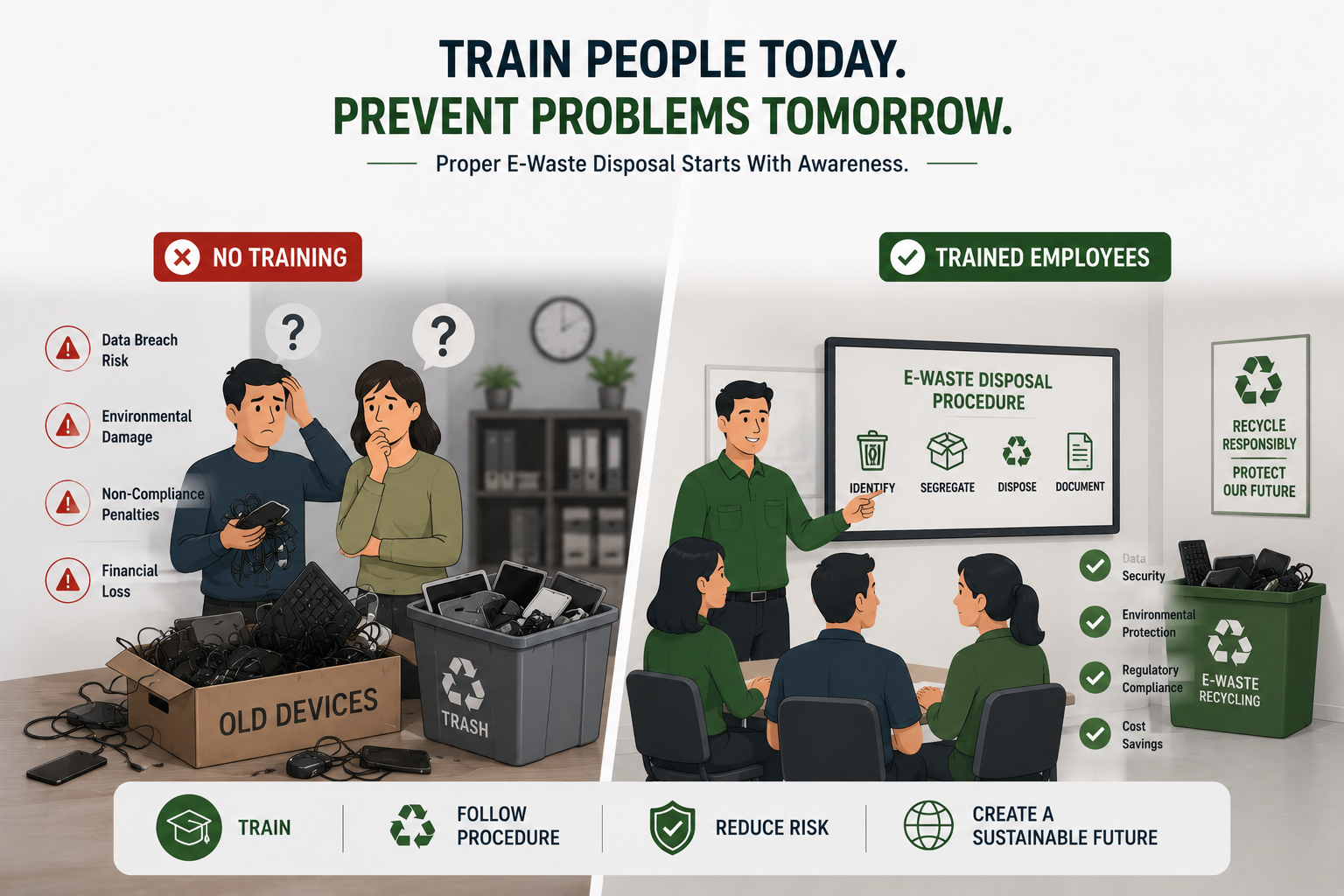
Without training, employees do not know what constitutes e-waste, where to bring it, why data must be wiped by a certified process rather than a personal reset, which devices qualify as data-bearing equipment, or what the consequences of improper disposal are for the company and for themselves.
Companies frequently donate old computers to schools without first wiping them. IT teams send servers to recyclers without verifying data destruction methods. Finance departments dispose of hard drives without considering the documents stored on them. These are not malicious acts. They are knowledge gaps, and knowledge gaps are trainable.
What to Do Instead
Make e-waste disposal a component of standard employee onboarding and annual compliance training. Cover the basics: what qualifies as e-waste, where and how to submit devices for disposal, why personal deletion methods are insufficient, and who to contact when a device is ready for retirement. Create visible, accessible collection points within the office so that doing the right thing requires no additional effort. Post clear signage at collection stations. Reinforce the policy through periodic reminders aligned with device refresh cycles. When employees understand both the why and the how, compliance follows naturally.
The Bigger Picture
Avoiding these seven mistakes is not complicated. It requires intention, a certified partner, and a documented process. When those three elements are in place, the risks collapse significantly.
Responsible office e-waste disposal is a combination of several things working together. It starts with a formal written policy that defines expectations across the organisation. It includes an asset tracking system that accounts for every device from purchase through final disposition. It requires certified data destruction at or before the point of handoff. It depends on a vetted, certified recycling partner that provides full documentation. And it involves trained employees who understand the policy and know how to follow it.
If the global recycling rate for e-waste were raised to 60% by 2030, the economic benefit from reduced environmental and health risks would exceed implementation costs by more than $38 billion. The business case for responsible disposal compounds across risk reduction, regulatory compliance, asset recovery, ESG credibility, and environmental contribution.
SND Recycler works with companies of all sizes to manage bulk e-waste disposal at scale. From scheduled pickups to certified data destruction and full chain-of-custody documentation, the process is designed to eliminate every one of the mistakes outlined above.
Need a Secure Office E-Waste Disposal Partner?
Whether you are upgrading office laptops, clearing old storage rooms, decommissioning IT assets, or managing a company-wide refresh cycle, SND Recycler helps businesses handle e-waste securely, compliantly, and responsibly.
From certified data destruction and asset tracking to bulk pickups and environmentally compliant recycling, our process is designed to reduce risk at every stage of disposal.
Call: +91-8810585812 / 1800 890 4830
Email: info@sndrecycler.com
Visit: sndrecycler.com
Our team will help you schedule a secure pickup, verify inventory, maintain chain-of-custody documentation, and ensure responsible recycling of all retired electronic assets.
Don’t Let Retired Devices Become Future Risks
Old laptops, servers, printers, storage drives, and office electronics may no longer be in use, but the data and compliance risks connected to them still remain. Improper disposal can lead to data breaches, regulatory penalties, environmental violations, and long-term reputational damage.
Partner with SND Recycler to ensure your office e-waste is managed through certified processes, secure handling, and documented disposal practices built for modern business compliance.
Learn more about bulk e-waste recycling services in India.
FAQs
Q: What counts as e-waste in a corporate office setting?
A: E-waste includes any electronic or electrical device at the end of its useful life. In an office context, that means laptops, desktop computers, monitors, servers, printers, copiers, fax machines, phones, tablets, cables, keyboards, mice, UPS units, projectors, and smart office devices. If it has a battery, plug, or circuit board, it qualifies as e-waste and must be disposed of through proper channels.
Q: Is it enough to do a factory reset before handing a device to a recycler?
A: No. A factory reset or standard file deletion removes file system pointers but does not erase the underlying data. Forensic recovery tools can retrieve that information from devices that appear to have been cleared. Certified data destruction following NIST SP 800-88 standards, which includes overwriting, degaussing, or physical destruction depending on device type, is required to ensure data is irrecoverable.
Q: What certifications should a corporate e-waste recycler hold?
A: The two most recognised certifications in the e-waste industry are R2 (Responsible Recycling) and e-Stewards. Both require third-party audits of environmental practices, data security protocols, and downstream vendor management. NAID AAA certification is an additional credential relevant specifically to data destruction services. Always ask for documentation of current certification before engaging a recycling partner.
Q: Can our company be held liable if our recycler handles e-waste improperly?
A: Yes. Under the U.S. RCRA "cradle to grave" liability framework, the business that generates waste retains legal responsibility for how that waste is handled downstream, even after it has been handed off to a third party. If your recycler violates environmental regulations or causes a data breach, your organisation may share liability. That is why vetting and certifying your recycling partner is not optional.
Q: How often should a company schedule e-waste pickups?
A: The right frequency depends on company size, device refresh cycles, and the volume of retired equipment. Most medium to large industries benefit from a quarterly or semi-annual scheduled pickup, rather than waiting until storage rooms are overflowing. A bulk e-waste management partner can help design a collection schedule aligned with your technology lifecycle and facility footprint.
Q: What documentation should we receive after e-waste is collected?
A: At minimum, you should receive a Certificate of Data Destruction for all data-bearing devices and a Certificate of Recycling confirming environmentally compliant processing. A reputable partner will also provide serialised asset tracking records and chain-of-custody documentation for each device. Retain these records for compliance audit purposes, as regulators under HIPAA, GDPR, and environmental statutes may require them.
Q: Does e-waste disposal qualify as part of our company's ESG reporting?
A: Yes. Responsible e-waste disposal directly addresses environmental and governance dimensions of ESG frameworks. Metrics such as the volume of e-waste responsibly recycled, certified data destruction rates, and documented compliance with environmental regulations are increasingly reported in corporate sustainability disclosures and evaluated by investors, enterprise clients, and rating agencies.
Q: What happens to the valuable materials in office electronics when they are recycled properly?
A: Electronic devices contain recoverable materials including gold, silver, copper, platinum, palladium, and rare earth elements. Certified recyclers extract and recover these materials through controlled processes, feeding them back into manufacturing supply chains. This recovery reduces the need for virgin raw material extraction, lowers the carbon footprint of electronics manufacturing, and generates residual value that reputable recyclers may share with the businesses that provide devices for processing.
Q: Are there regulations specific to India regarding corporate e-waste disposal?
A: Yes. The E-Waste (Management) Rules, 2022, enforced by the Ministry of Environment, Forest and Climate Change, govern corporate e-waste disposal in India. The rules require producers, bulk consumers, and recyclers to meet specific responsibilities under an Extended Producer Responsibility framework. Bulk consumers, which includes corporate offices above defined thresholds, are required to route e-waste only to authorised dismantlers and recyclers and to maintain records of disposal. Non-compliance can result in penalties under the Environment Protection Act, 1986.
Electronic Waste Recycling
READY TO SPEAK WITH A RECYCLING SPECIALIST?
At S&D Recycler , we make it easy for organizations to do the RIGHT thing with their End of Life Electronic (EOL) IT Equipment. Honest, reliable & secure electronic waste recycling services.