
How Hospitals Should Dispose of Old Medical Electronics
Learn how hospitals should dispose of old medical electronics safely, stay HIPAA and EPA compliant, and partner with a certified bulk e-waste recycler
Table of Contents
- The E-Waste Crisis Inside Hospitals
- What Counts as Medical Electronic Waste?
- Why Hospitals Cannot Afford to Ignore Proper Disposal
- The Regulatory Framework Every Hospital Must Know
- The Data Security Dimension: Where HIPAA Meets E-Waste
- How Hospitals Should Dispose of Old Medical Electronics
- What to Look for in a Certified Medical E-Waste Partner
- The Environmental and Financial Case for Responsible Recycling
- How SND Recycler Supports Hospitals with Bulk E-Waste Management
- Frequently Asked Questions
The E-Waste Crisis Inside Hospitals
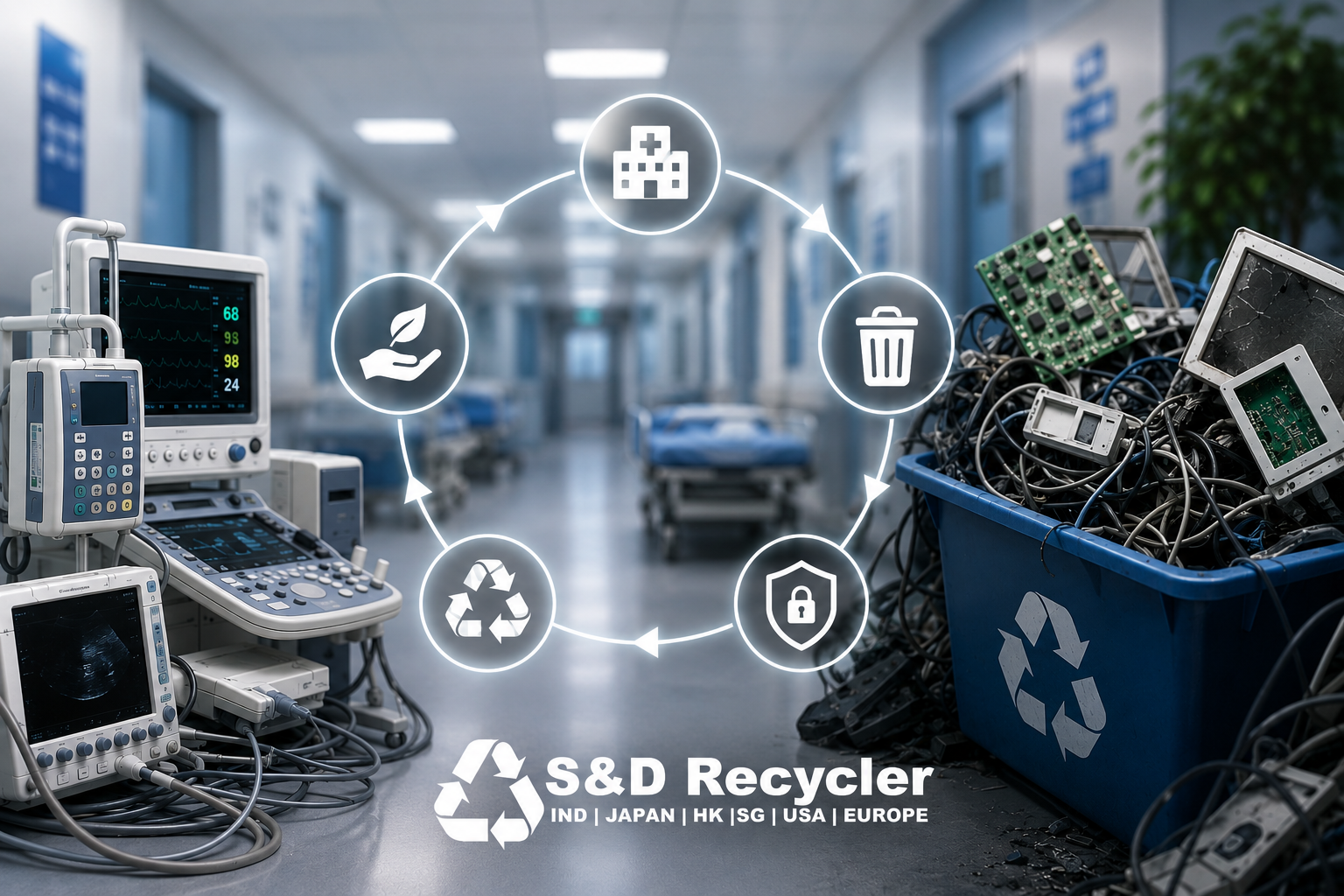
Walk through any hospital hallway today and you will find technology at every turn. Vital sign monitors, infusion pumps, imaging machines, bedside computers, portable ultrasound devices, digital X-ray panels, and a sprawling network of connected healthcare infrastructure. What patients rarely see, however, is what happens to all that equipment when it reaches the end of its useful life.
Hospitals across the globe are sitting on a growing mountain of outdated, broken, or replaced medical electronics, and most are managing that mountain with policies that are years out of date. The global medical waste management market was valued at approximately USD 15.7 billion in 2024 and is projected to grow at a CAGR of 7.4% through 2034, driven in large part by the sheer volume of electronics flowing out of healthcare facilities every year.
The question of how hospitals should dispose of old medical electronics is no longer just an operational afterthought. It is a compliance obligation, a data security imperative, and an environmental responsibility that affects everything from a hospital's regulatory standing to the safety of communities living near informal dumping sites.
This guide breaks down every layer of that responsibility, from the regulatory maze hospitals must navigate to the practical, step-by-step process of executing a compliant, certified medical electronics disposal program.
What Counts as Medical Electronic Waste?
Before a hospital can build a disposal strategy, it needs a clear inventory of what qualifies as medical electronic waste. This category is broader than most administrators assume.
Diagnostic and Imaging Equipment covers MRI machines, CT scanners, digital X-ray panels, portable ultrasound units, and electrocardiogram machines. These are high-value, high-complexity devices that contain lead, cadmium, and rare earth elements.
Patient Monitoring Devices include bedside vital sign monitors, pulse oximeters, blood pressure monitoring systems, fetal monitors, and wearable cardiac telemetry units.
Laboratory and Analytical Equipment spans digital analysers, centrifuges with embedded processors, automated blood gas analysers, DNA sequencers, and spectrometers.
Hospital IT Infrastructure covers desktops, laptops, tablets, servers, networking switches and routers, printers, barcode scanners, and nurse call systems.
Infusion and Treatment Devices include smart infusion pumps, insulin delivery systems, phototherapy units, and programmable ventilators.
Communication and Administrative Electronics encompass VOIP handsets, intercoms, paging systems, security cameras, and electronic health record (EHR) terminals.
Each of these categories carries its own disposal complexity. A bedside monitor is not managed the same way as a server that once stored thousands of patient records. A portable X-ray machine contains components regulated under environmental law that a standard IT asset disposal company is not equipped to handle.
Why Hospitals Cannot Afford to Ignore Proper Disposal
The consequences of mismanaged medical electronic waste operate on three levels: legal, environmental, and reputational. Each carries weight that is significant enough on its own. Together, they create a liability exposure that no hospital leadership team should be willing to accept.
Legal and Financial Penalties
The regulatory framework governing how hospitals should dispose of old medical electronics spans multiple federal agencies and dozens of state-level authorities. Non-compliance with EPA regulations under the Resource Conservation and Recovery Act (RCRA) can result in fines that reach tens of thousands of dollars per violation per day. HIPAA violations tied to improper disposal of data-bearing devices carry penalties ranging from USD 100 to USD 50,000 per violation, with a maximum annual penalty of USD 1.9 million for repeated violations.
Environmental Harm
Electronics contain a concentrated mixture of harmful substances. Lead, mercury, cadmium, beryllium, and brominated flame retardants are all present in standard hospital electronics. When these materials are landfilled or incinerated without proper controls, they leach into soil and water systems, contaminating drinking water and agricultural land. The World Health Organization reports that approximately 15 to 20 percent of all medical waste is classified as high-risk, infectious, or radioactive, and electronic waste contributes a disproportionate share of the toxic load.
Reputational Damage
A data breach traced back to improperly disposed hospital computers or servers is not just a financial hit. It is a headline. The reputational fallout from a HIPAA breach involving patient records found on discarded equipment has ended careers and shut down facilities. In a healthcare landscape where patient trust is a competitive differentiator, that is a risk no administrator should be comfortable taking.
The Regulatory Framework Every Hospital Must Know
Understanding the regulatory environment is non-negotiable for any hospital building a disposal program. The oversight is layered, and ignorance of any one layer is not a valid defense during an audit or enforcement action.
The Resource Conservation and Recovery Act (RCRA)
Administered by the EPA, RCRA governs dangerous waste from the point of generation through final disposal. This is often called the "cradle to grave" standard. Hospitals generating risky electronic waste must obtain EPA ID numbers, maintain accurate manifests, and ensure all waste is transported to a permitted Treatment, Storage, and Disposal Facility (TSDF). Large Quantity Generators (LQGs) and Small Quantity Generators (SQGs) were required to register in the EPA's national system and designate a certified site manager by January 2025, making compliance documentation more critical than ever.
State Environmental Regulations
Since the Medical Waste Tracking Act expired in 1991, the federal EPA has not held comprehensive authority specifically over medical waste. This pushes primary regulatory responsibility to state environmental and health departments. As of 2026, 25 states plus Washington D.C. have enacted standalone e-waste recycling laws, several of which expanded requirements in the current year. Every hospital must consult its state environmental protection agency and state health agency to ensure it understands the specific requirements that apply to its location.
OSHA Standards
The Occupational Safety and Health Administration governs the safe handling of obsolete electronic materials in the workplace. Hospital employees involved in moving, packaging, or staging old medical electronics for disposal must follow OSHA protocols for hazardous material exposure, including proper use of personal protective equipment and appropriate container labeling.
FDA Regulations on Medical Device Disposal
For certain classes of regulated medical devices, the Food and Drug Administration has specific guidance on end-of-life handling to prevent devices from re-entering the market in unauthorised ways. This is particularly relevant for implantable devices, infusion systems, and diagnostic equipment.
Title 49 CFR: Transportation of Harmful Electronic Materials
When medical electronics are transported for disposal, they may qualify as high risk electronic materials under Department of Transportation regulations. Part 173.197 of the Code of Federal Regulations specifically addresses regulated medical waste, and hospitals must ensure their disposal vendors comply with packaging, labeling, and shipping documentation requirements.
The Data Security Dimension: Where HIPAA Meets E-Waste
This is the intersection that catches most hospitals off guard. The question of how hospitals should dispose of old medical electronics is inseparable from the question of what data those electronics contain.
Under the HIPAA Security Rule, specifically 45 CFR Section 164.310(d)(1), covered entities are required to implement policies and procedures that address the final disposition of electronic Protected Health Information (ePHI) and the hardware or electronic media on which it is stored. Simply deleting files or performing a standard factory reset does not meet this standard.
The scope of this obligation is wider than hospitals typically assume. ePHI can reside on imaging machines that store scans locally, infusion pumps with embedded memory logs, EHR terminals, nurse call systems, portable diagnostic devices, and virtually any networked hospital equipment. Each of these represents a potential breach vector if not properly wiped or destroyed before leaving the facility.
The acceptable methods for meeting the HIPAA data destruction standard include physical destruction (shredding or crushing the storage media), degaussing (using a powerful magnetic field to erase magnetic storage), and certified software-based overwriting performed to a recognised standard such as NIST 800-88. All of these must be documented with a certificate of data destruction that names the device, the destruction method, the date, and the certifying party.
In 2026, healthcare IT managers face what one compliance analysis describes as a "dual-compliance gap" where HIPAA violations and state e-waste violations can arise from the same improperly disposed device. Getting a certificate of recycling from a vendor that cannot also provide a certificate of data destruction is not sufficient compliance.
Step-by-Step: How Hospitals Should Dispose of Old Medical Electronics
This is the practical core of what every hospital procurement, facilities, and compliance team needs to implement. The following process is designed to satisfy HIPAA, RCRA, and applicable state e-waste requirements simultaneously.
Step 1: Conduct a Comprehensive Device Inventory
Before any disposal activity begins, the hospital must know exactly what it has. Build a device inventory that captures the asset tag or serial number, the device type and manufacturer, the last date of clinical use, whether it contains or has contained ePHI, and its current physical condition.
This inventory serves two purposes. It creates the documentation foundation for compliance and it identifies which devices might have resale or refurbishment value, which can offset disposal costs.
Step 2: Classify Devices by Regulatory Category
Not every old medical electronic falls under the same disposal pathway. Use the inventory to sort devices into categories. Devices containing ePHI must go through HIPAA-compliant data destruction before any other handling. Devices containing dangerous materials such as monitors with mercury backlights or batteries with cadmium must be flagged for certified e-waste handling. Standard IT equipment can typically follow a conventional IT asset disposal (ITAD) pathway, provided the vendor holds appropriate certifications.
Step 3: Quarantine and Secure All Retired Devices
Retired electronics should never sit in unlocked storage areas, hallways, or dumpsters while awaiting disposal. Establish a secure, access-controlled staging area specifically for end-of-life equipment. All devices in this area should be logged and tracked until they leave the facility with a certified vendor.
Step 4: Engage a Certified E-Waste Recycling Partner
This is the single most consequential decision in the entire disposal process. A certified bulk e-waste management company brings together all the compliance threads that hospitals cannot manage on their own. The vendor must hold recognised certifications (discussed in detail in the next section), provide documented chain-of-custody tracking, and issue both a certificate of data destruction and a certificate of recycling for every device processed.
For hospitals generating large volumes of retired equipment, partnering with a bulk e-waste management company is far more cost-effective and compliant than managing individual device disposals through multiple vendors.
Step 5: Execute Data Destruction Before Device Transfer
Data destruction must occur before devices leave the hospital's custody, or the vendor must take custody under a Business Associate Agreement (BAA) and perform destruction as their first act upon receiving the devices. Any gap in custody documentation between the moment a device leaves the hospital and the moment data is destroyed represents a potential HIPAA breach window.
Step 6: Obtain and Archive All Compliance Documentation
After disposal, the hospital must retain the following records for a minimum of six years under HIPAA requirements and potentially longer under state environmental regulations. These records include the complete device inventory, the chain-of-custody manifest from transport, the certificate of data destruction for each ePHI-bearing device, the certificate of recycling from the e-waste vendor, and the EPA waste manifests for any risky materials.
Step 7: Conduct a Post-Disposal Audit
A periodic review of the disposal program should be built into the hospital's compliance calendar. This audit should verify that vendor certifications are current, that all documentation is complete and stored correctly, and that the disposal policy reflects any regulatory changes at the state or federal level.
What to Look for in a Certified Medical E-Waste Partner
Choosing the right e-waste disposal partner is one of the most important procurement decisions a hospital makes. The certifications a vendor holds are not marketing badges. They are evidence that the vendor has been audited by an independent body against specific environmental and security standards.
R2v3 Certification (Responsible Recycling Standard)
The R2v3 standard, administered by SERI (Sustainable Electronics Recycling International), is the most widely recognised certification for electronics recyclers in North America. It requires rigorous downstream tracking, ensuring that materials recovered from recycled electronics are processed responsibly throughout the entire supply chain and not shipped to developing countries for informal processing.
e-Stewards Certification
e-Stewards is an alternative to R2 that specifically prohibits the export of harmful e-waste to developing nations. For hospitals with a strong environmental mandate or sustainability reporting requirements, e-Stewards certification is a meaningful differentiator.
NAID AAA Certification
The National Association for Information Destruction (NAID) AAA certification specifically addresses data destruction. A NAID AAA certified vendor has been unannounced-audited against rigorous standards for the security of data destruction operations. For hospitals, this certification is essential for any vendor that will handle ePHI-bearing devices.
ISO 14001 Certification
ISO 14001 is an internationally recognised standard for environmental management systems. Vendors holding this certification have demonstrated systematic management of their environmental impact across their operations.
Business Associate Agreement Capability
Any vendor that takes custody of devices that may contain ePHI must be willing to sign a Business Associate Agreement with the hospital. A legitimate certified vendor will have a standard BAA ready. A vendor that resists signing one is a red flag.
The Environmental and Financial Case for Responsible Recycling
Responsible medical electronics recycling is not purely a cost. For hospitals that approach it strategically, it creates measurable financial and environmental returns.
Recovered Material Value
The raw materials embedded in electronic waste have significant economic value. In 2022, the global e-waste stream contained materials valued at USD 91 billion, with only USD 19 billion recovered through environmentally sound recycling. Gold, silver, palladium, copper, and rare earth elements are recoverable from medical electronics, and reputable recyclers share a portion of that recovered value with clients generating significant volumes of material.
Reduced Landfill Liability
Hospitals that landfill or improperly dispose of unused electronic waste expose themselves to long-term environmental liability. If a disposal site is later identified as a contaminated location, the original generators of waste deposited there can be held responsible for remediation costs under environmental law, regardless of how long ago the disposal occurred.
ESG Reporting and Sustainability Commitments
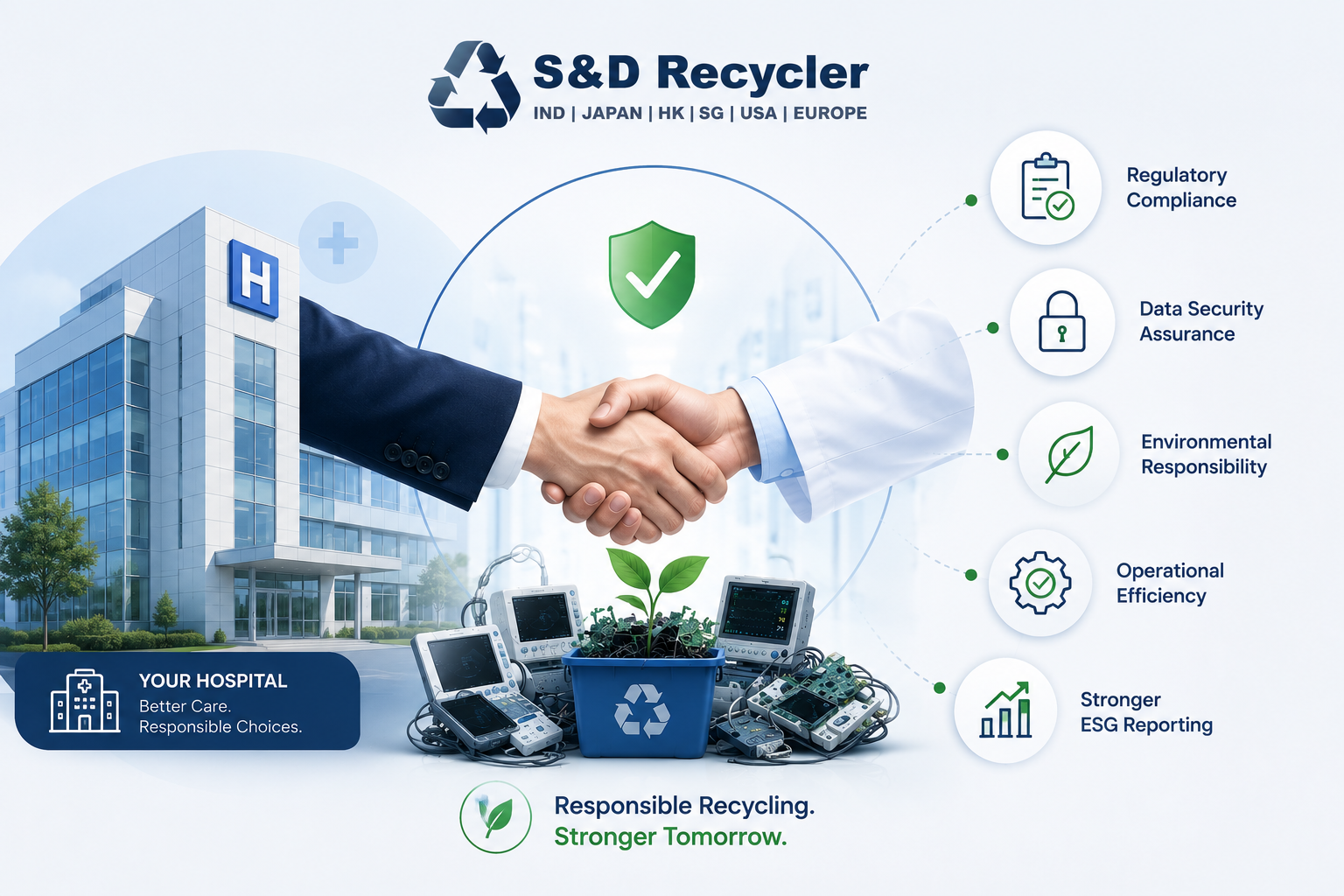
Healthcare systems with Environmental, Social, and Governance (ESG) commitments or sustainability targets benefit directly from documented e-waste recycling programs. Certified recycling with documented diversion rates from landfill contributes directly to waste diversion metrics and greenhouse gas reduction reporting.
Carbon Footprint Reduction
Manufacturing new electronics from raw materials is far more energy-intensive than recovering materials from existing devices. By ensuring that retired medical electronics are recycled through certified channels, hospitals contribute to a circular economy that reduces the carbon cost of new electronics production.
How SND Recycler Supports Hospitals with Bulk E-Waste Management
SND Recycler is a specialised bulk e-waste management company built to serve the complex, high-volume disposal needs of healthcare facilities, hospital networks, and healthcare supply chains.
Unlike general electronics recyclers, SND Recycler understands that the question of how hospitals should dispose of old medical electronics is not just a logistics question. It is a compliance question, a data security question, and an environmental stewardship question, all at the same time.
What SND Recycler Offers Healthcare Clients
SND Recycler provides end-to-end management of retired medical electronics, beginning with on-site pickup from the hospital's secure staging area and concluding with the delivery of complete compliance documentation. Every device processed through SND Recycler is tracked through a documented chain of custody from the moment it leaves the hospital's premises.
For ePHI-bearing devices, SND Recycler performs certified data destruction and issues HIPAA-aligned certificates of data destruction for every device, with serialised records that match the hospital's asset inventory.
For devices classified as harmful waste under RCRA, SND Recycler manages all manifest documentation and ensures materials are processed at permitted, certified facilities in full compliance with state and federal environmental regulations.
For hospitals managing high volumes of retired equipment, whether from a technology refresh cycle, a facility closure, or ongoing operational replacement, SND Recycler's bulk e-waste management model delivers economies of scale that individual device disposal programs cannot match.
To learn more about how SND Recycler can build a custom medical electronics disposal program for your facility or hospital network, contact the SND Recycler team directly for a compliance consultation.
FAQs
Q1. What is the legal requirement for hospitals when disposing of old medical electronics?
Hospitals must comply with multiple overlapping regulatory frameworks. The EPA's Resource Conservation and Recovery Act governs high-risk waste components in electronics. HIPAA's Security Rule requires certified destruction of all electronic Protected Health Information before devices leave the hospital's custody or a Business Associate's certified control. State e-waste laws add additional requirements that vary by location. Hospitals should consult their state environmental protection agency and state health agency in addition to meeting federal standards.
Q2. Can a hospital simply delete data from a device before disposing of it?
No. Standard file deletion does not meet the HIPAA standard for media sanitisation. Acceptable methods include physical destruction of storage media, degaussing of magnetic storage, or certified software-based overwriting performed to NIST 800-88 standards. All destruction must be documented with a certificate that includes the device serial number, the destruction method used, the date, and the name of the certifying party.
Q3. What certifications should a hospital require from its e-waste recycling vendor?
At a minimum, hospitals should require R2v3 or e-Stewards certification for the recycling operation and NAID AAA certification for data destruction. Vendors should also be willing to sign a Business Associate Agreement if they will handle any devices that may contain ePHI. ISO 14001 certification is an additional indicator of environmental management quality.
Q4. How often should hospitals conduct a medical electronics disposal program review?
A formal review should be conducted at least annually. This review should verify that the vendor's certifications are current, that all disposal documentation from the past year is complete and accessible, that the hospital's internal device inventory process is functioning correctly, and that the disposal policy has been updated to reflect any changes in state or federal regulations. Facilities undergoing major technology refreshes should also trigger an out-of-cycle review.
Q5. What types of medical electronics are considered harmful waste?
Several categories of medical electronics contain substances that qualify as high-risk under RCRA. Older CRT monitors contain significant quantities of lead. Fluorescent backlit displays and some laboratory instruments contain mercury. Batteries in portable devices often contain cadmium or lithium that requires specific handling. Circuit boards contain lead solder and brominated flame retardants. Imaging equipment such as X-ray machines may contain beryllium. All of these require disposal through a vendor certified for harmful material processing.
Q6. What is a chain of custody document and why does it matter for hospital e-waste disposal?
A chain of custody document is a formal record that tracks every transfer of custody for a device from the moment it is retired to the moment its materials are finally processed. It names who held the device, when it was transferred, what security measures were in place during transport, and what happened to the device at each step. For hospitals, chain of custody documentation is critical evidence during a HIPAA audit or an EPA compliance review that demonstrates the hospital acted responsibly with every device.
Q7. Can hospitals sell old medical equipment instead of recycling it?
In some cases, yes. Devices that are functional, hold no residual patient data, and are not regulated as harmful waste can potentially be resold or donated. However, this pathway requires the same level of data sanitisation as full disposal, and hospitals must ensure the device is not subject to FDA restrictions on re-entry into clinical use. Working with a certified IT asset disposition (ITAD) partner who can assess resale eligibility while performing compliant data destruction is the safest approach.
Q8. How does bulk e-waste management benefit hospitals compared to individual device disposal?
Bulk e-waste management consolidates all disposal activity through a single certified partner, which simplifies compliance documentation, reduces per-unit disposal costs through economies of scale, ensures consistent data destruction standards across every device type, and provides a single point of accountability for all compliance records. For hospital networks managing multiple facilities or large-volume technology refresh cycles, the operational and financial advantages of bulk management are substantial.
Electronic Waste Recycling
READY TO SPEAK WITH A RECYCLING SPECIALIST?
At S&D Recycler , we make it easy for organizations to do the RIGHT thing with their End of Life Electronic (EOL) IT Equipment. Honest, reliable & secure electronic waste recycling services.